

Inlays & Onlays
When a tooth has too much damage for a simple filling but not enough to need a full crown, an inlay or onlay fills that gap. They’re custom made restorations, fit precisely to your tooth, stronger than a composite filling and gentler on your tooth than a crown.
Think of them as the middle option. Not a patch, not full coverage. A targeted repair that keeps as much of your natural tooth as possible. If a crown isn’t needed, Dr. Stout won’t talk you into one.
It comes down to where the restoration sits. An inlay fits inside the cusps of a back tooth, filling a specific area of damage. An onlay covers one or more cusps, reaching over a larger part of the chewing surface. Both are made outside the mouth and then bonded onto the tooth.
We use tooth colored ceramic or porcelain. It matches your natural shade, handles the force of chewing, and doesn’t expand and contract with temperature the way metal can. The result is a strong, natural looking repair for back teeth.
An inlay or onlay may be the right call if:
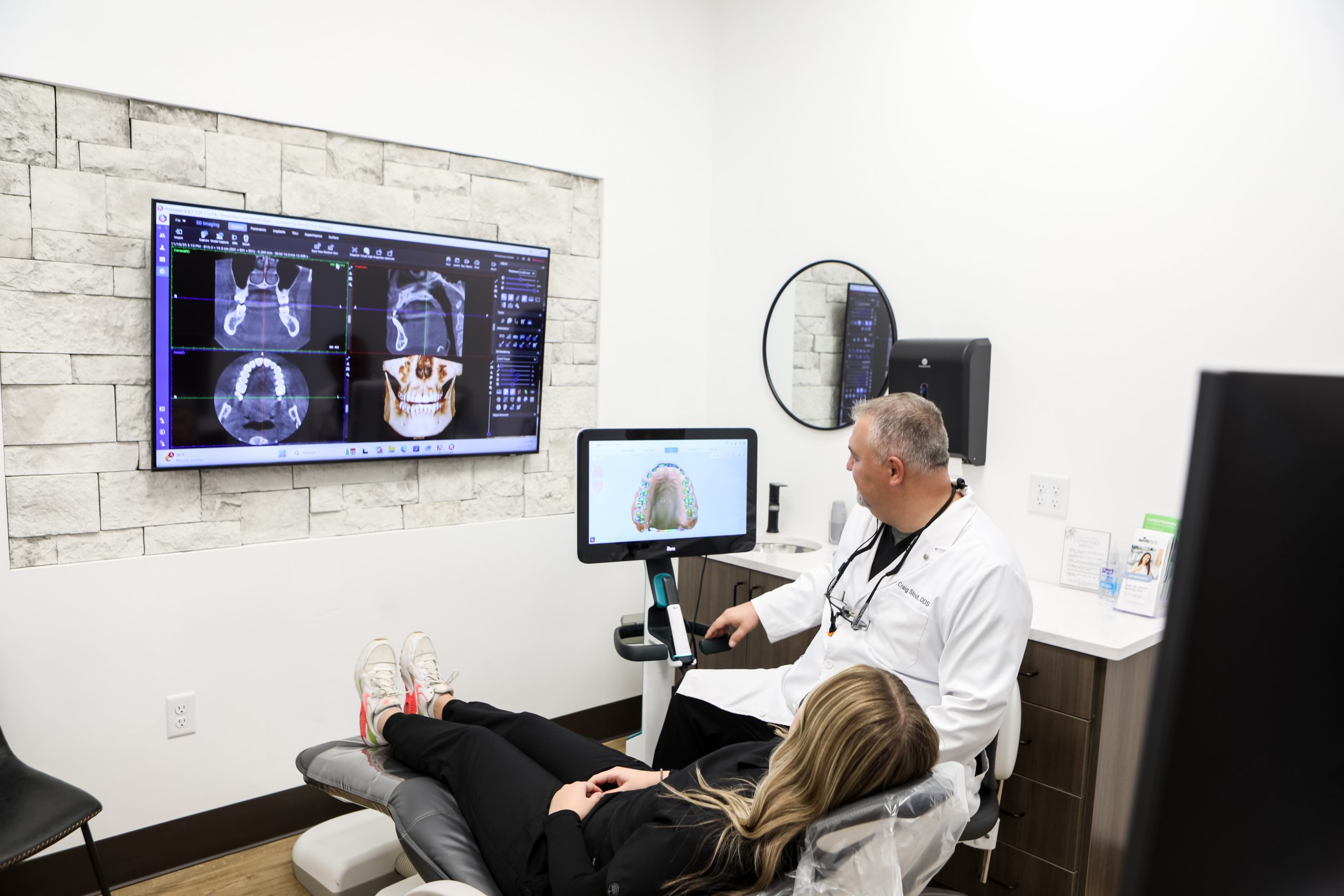
It usually takes two visits. At the first, we remove the damaged material, take a precise scan, and place a temporary. At the second, we bond the finished restoration and fine tune the bite. Dr. Stout walks you through the timeline for your tooth, and you’ll get a clear cost estimate before anything starts.
In nearly 20 years of dentistry in eastern Idaho, Dr. Craig Stout has restored a lot of teeth. He’d rather save natural tooth structure than grind a healthy tooth down for a crown. If your tooth can be saved with a targeted restoration, that’s his first choice. Patients come to Family First Dental from Rexburg, Rigby, Sugar City, St. Anthony, and across the area for restorative care.
A crown caps the whole tooth, so the dentist shapes the entire tooth down to make room for it. An inlay or onlay only replaces the part that’s actually damaged. You keep more of your own healthy tooth, and that usually means a stronger tooth over the long run. If a tooth truly does need a crown, Dr. Stout will explain why before he recommends one.
There’s no special routine. Brush twice a day and floss the way you normally would. Try not to chew ice or hard candy on that tooth, since that can chip any restoration. If you grind your teeth at night, a night guard helps protect the work. We check the inlay or onlay at each regular cleaning to make sure the fit and the bite are still right.
Coverage depends on your plan, and many plans treat inlays and onlays differently than a standard filling or a crown. We check your benefits with you and give you an exact estimate before any treatment starts, so there are no surprises on the bill. If you’d rather spread the cost out, we offer WellCredit and Cherry financing.
A few things often point to an inlay or onlay: a sharp twinge when you bite down, a rough or broken edge you can feel with your tongue, a filling that fell out, or an old silver filling that’s cracking around the edges. If any of that sounds familiar, it’s worth getting the tooth looked at before it gets worse.
They’re built for the back teeth that do the heavy chewing. They aren’t the right tool for a front tooth you want to look different, where bonding or a veneer fits better. And if a tooth is badly broken or the decay has reached the nerve, you may need a crown or a root canal instead. Dr. Stout will be straight with you about which one your tooth actually needs.
Instead of the old tray full of putty, we take a digital scan of your tooth. It’s more comfortable, there’s no gagging on impression material, and the fit tends to be more precise. That precise fit is part of why a well made inlay or onlay can last so long.
It’s a fair question. A large filling on a back tooth has to flex every time you chew, and over the years that flexing can crack the tooth around it. An inlay or onlay is made as one solid, custom piece and bonded into place, so it spreads the force more evenly and supports the tooth instead of stressing it. That’s the real reason we step up from a filling when the damage is large.
Have a tooth that needs more than a filling? Call Family First Dental at (208) 400-9946 to book in Rexburg. Evening and Saturday appointments are available.
Our friendly team at Family First Dental is here to help! Contact our office in Rexburg today and let us take care of your dental health.
Lorem ipsum dolor sit amet, consectetur adipiscing elit. Ut elit tellus, luctus nec ullamcorper mattis, pulvinar dapibus leo.